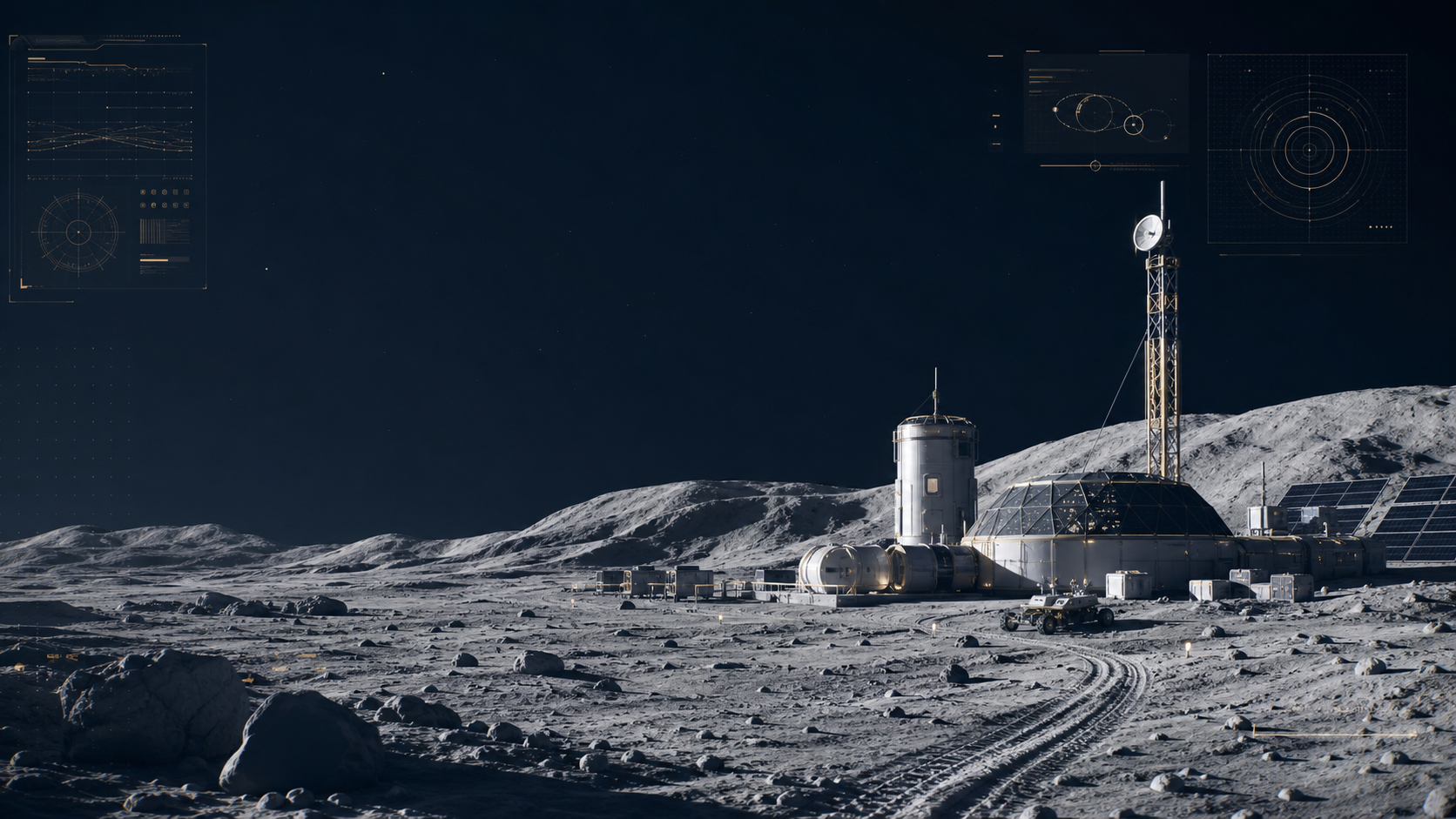
Phased governance research

Lunar governance and settlement planning.

A realistic research program for how lunar governance systems could evolve from current law, current capabilities, real geography, and plausible future development.

At a glance

Institutional design for durable lunar activity.

The Lunar Project models how governance could evolve from today’s law and missions into future settlement institutions.

  • Present facts stay separate from hypothetical scenarios.
  • Focus: infrastructure, safety, resources, public services, and representation.
  • Output: an integrated lunar governance model.
Why this matters

Rules should arrive before routine settlement.

Coordination pressure

Fragmented governance, infrastructure coordination, resource competition, safety, and public health may become practical problems as activity increases.

Legitimacy and continuity

Representation, accountability, dispute resolution, legal continuity, and international legitimacy matter before operational practices harden into expectations.

Long-term sustainability

Environmental stewardship, conflict prevention, and durable public administration are governance problems, not only technical mission problems.

Current context

Separate present activity from modeled futures.

What exists now

  • Treaties and national authorization systems.
  • Agency programs and commercial missions.
  • Technical limits: transport, power, communications, life support, dust, and surface operations.

What the project models

  • Future settlements and governance bodies.
  • Public services and resource-management tools.
  • Inter-settlement coordination.

Foundational propositions

Principles for responsible scenario design.

01

Build incrementally from current law.

02

Legitimacy needs transparency and representation.

03

Settlement governance is more than property law.

04

Health, safety, infrastructure, and environment are governance issues.

Project framework

Workstreams for lunar public administration.

Legal framework

Outer Space Treaty principles, national authorization, responsibility, liability, and institutional continuity.

Institutional design

Governance bodies, registries, public records, representation, and accountability.

Settlement administration

Local services, dispute intake, records, standards, and public-facing procedures.

Infrastructure and logistics

Landing zones, power, communications, mobility corridors, and shared systems.

Resource governance

Scarcity rules, transparency, monitoring, and coordination with non-appropriation principles.

Diplomacy and external relations

Interfaces with states, operators, researchers, and international institutions.

Operations interface

Mission-control simulation panel.

A compact scenario interface for rovers, base systems, and governance queues.

ModeRover traverse
Signal8.4 s delay
Power72%
RiskDust corridor review
Governance checkRoute notice and dust buffer
Next actionPublish traverse window

External simulator reference

CGI references LunCoSim as design inspiration only.

MoonDAO Project 248 LunCoSim alpha LunCoSim repository

Settlement and location framework

Explore proposed nodes as governance stress tests.

A research visualization, not a claim of existing lunar infrastructure.

Drag to rotate. Select a city to focus.

Hypothetical Lunar Administration concept seal with lunar horizon, orbital arc, and four node stars

Hypothetical institution

Lunar Administration

The Lunar Administration is a proposed governance concept for CGI scenario work. It is not an existing public body, treaty organ, or operational authority.

REG

Registry and transparency office

Maintain public records, notices, operator filings, and settlement activity logs.

LZ

Landing zone coordination

Coordinate landing areas, traffic windows, safety notices, and exclusion timing.

SAFE

Safety and emergency coordination

Support rescue protocols, emergency authority, warnings, and shared risk reporting.

GRID

Infrastructure access

Set fair-use rules for power, communications, mobility corridors, and shared systems.

SCI

Scientific site protection

Protect high-value research zones, instrument fields, samples, and open-data practices.

RES

Resource activity interface

License resource-support activity, monitor impacts, and coordinate scarcity rules.

ENV

Environmental monitoring

Review contamination risks, dust impacts, waste handling, and site-preservation data.

MED

Dispute intake and mediation

Provide an early channel for operational conflicts before escalation becomes political.

STD

Standards coordination

Align habitat, mobility, communications, safety-buffer, and public-reporting practices.

Sustainable space operations

Governance that keeps the operating environment usable.

Sustainability is treated as an operations discipline: fewer avoidable conflicts, clearer duties, and shared infrastructure rules before fragile sites become crowded.

Dust

Dust and contamination control for landing, mobility, habitats, and instrument fields.

Waste

End-of-life planning for equipment, packaging, surface debris, and abandoned systems.

Traffic

Landing-zone deconfliction, safety buffers, route notices, and emergency priority.

Power

Shared power, communications, and corridor access rules for scarce infrastructure.

Science

Protection of high-value research sites, samples, sensors, and open-data practices.

Resources

Transparent resource-use reporting, monitoring, and scarcity review.

Rescue

Emergency and rescue obligations for public missions, private operators, and visitors.

Heritage

Preservation of historic, cultural, and scientifically significant surface locations.

Methodology and evidence standard

Scenario planning must stay traceable.

Each claim is labeled as present fact, planned activity, projection, design proposal, or long-range scenario.

Present-day fact

Current law and activity

Treaty text, national authorization systems, real geography, and current missions.

Officially planned activity

Agency and operator plans

Publicly described missions, architectures, or programs.

Plausible projection

Nearer-term assumptions

Scenario assumptions tied to current capabilities and technical constraints.

Institutional design proposal

Governance architecture

Proposed public functions, procedures, and coordination bodies.

Long-range scenario

Stress-test future

Hypothetical settlement and institutional models used to reveal governance needs.

Roadmap

From foundations to an integrated governance model.

  1. 01Legal and institutional foundations
  2. 02Settlement and infrastructure assumptions
  3. 03Governance architecture
  4. 04Public-service systems
  5. 05Expert review
  6. 06Integrated lunar governance model

Primary sources and foundations

Legal, mission, and geography materials.

Research participation

Interdisciplinary review is essential.

CGI welcomes legal, administrative, engineering, health, economics, planning, environmental, diplomatic, and security expertise.

Join or contact CGI

The Lunar Project distinguishes current law and present activity from projections and hypothetical institutional design. Its scenarios are research tools for policy analysis, not claims that lunar settlements or authorities presently exist.